
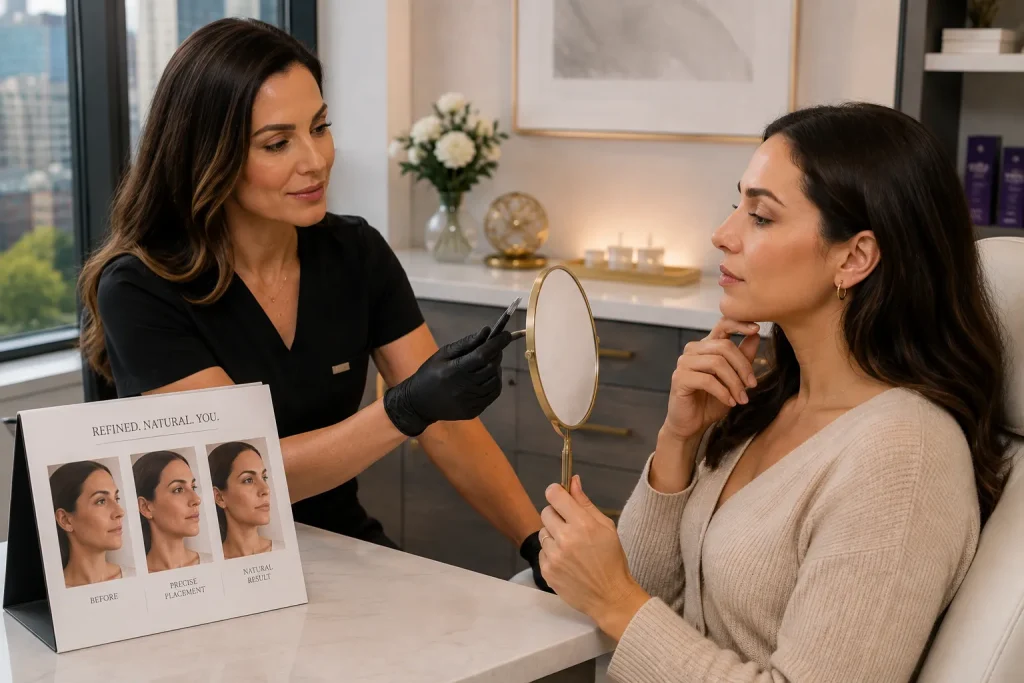
There is a version of filler results that most people do not want. The overfilled look, pillow-like, fullness, or strangely uniform, has become so recognizable that it has put a lot of people off injectables entirely. We hear it often at About Face Aesthetics: “I want to look better, but I do not want to look like I had work done.”
Natural filler results come from precision placement in the right anatomical layer rather than using more product. Overdone results typically build gradually across multiple visits rather than from a single session. A thorough facial assessment helps determine whether hyaluronic acid filler, a biostimulator like Sculptra, or a skin tightening treatment best fits the concern.
That concern is valid. And it points directly to something the aesthetics industry does not say often enough: more filler is not better filler. After more than 15 years of providing expert injectables in Philadelphia, the results we are most proud of are the ones where nobody can tell. Here is what actually goes into producing them.
What Actually Causes the Overdone Look
Overdone filler rarely happens in one session. It builds gradually. A small addition feels subtle, so the next visit brings a little more, and the pattern continues until the cumulative result has drifted far from natural without any single appointment looking obviously wrong. This is one of the most common reasons patients come to us after having work done elsewhere and asking for a fresh start.
Volume placed without structural intention also spreads and migrates over time. Lips lose their natural edge definition. Cheeks develop a rounded fullness that reads as product rather than anatomy. The midface can look heavy in a way that actually makes someone appear older rather than younger. These outcomes are predictable when the goal is volume rather than structure, and understanding that distinction is the first step in avoiding them.
Precision Placement Changes Everything
Restraint in filler is not simply about using less product. It is about placing what is used in the right anatomical layer, in the right location, and in the right amount for that specific patient. This level of precision is what separates a result that looks like the patient from one that looks like filler.
At About Face Aesthetics, we work with trusted filler brands including Juvederm, Restylane, and the RHA Collection. The RHA Collection is specifically formulated to move with facial expressions rather than sit stiffly, making it particularly well suited for areas like the lips and the lines around the mouth, where natural movement matters.
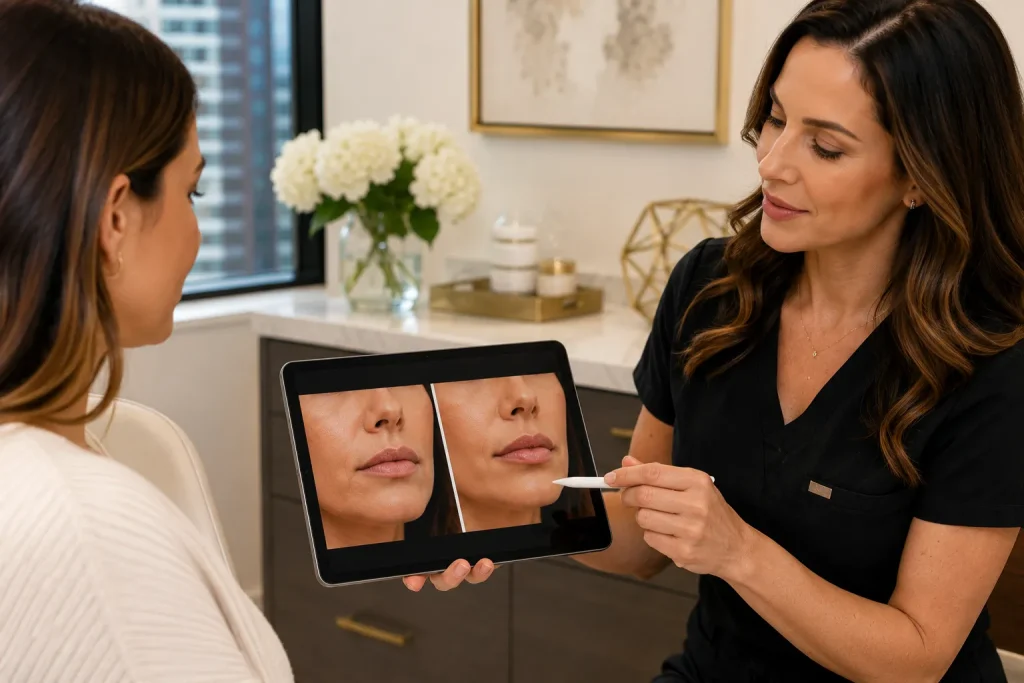
Every patient receives a thorough facial assessment before any product is recommended, because the best filler result starts long before a syringe is picked up. Selecting the right product for the right area is just as important as the technique used to place it.
Knowing When Filler Is Not the Right Answer
One of the most important parts of any good consultation is the conversation about what not to do. Skin laxity is often better addressed with Thermage FLX or RF microneedling with Morpheus8 than with filler. Adding volume to a face that actually needs lift or collagen support can make the tissue appear heavier without solving the real concern.
For patients who want gradual, natural improvement in lost volume, a biostimulator like Sculptra or a regenerative option like EZ Gel PRF is frequently a better fit than traditional hyaluronic acid filler, because both work with the body’s own collagen rather than adding external volume. Our job during a consultation is to identify what genuinely serves your face, not to default to what is most commonly requested.
What Patients Notice After Refined Work
The feedback we hear most often after a well-executed filler treatment is not about the specific area that was treated. Patients say they look rested, or that they seem like themselves again, or that friends have asked if they changed their skincare routine. Nobody asks if they had work done.
That response is the goal. It means the treatment enhanced the face without announcing itself. It means the result will age well because it was built on the real structure of the face rather than layered on top of it. That is the standard we hold to at About Face Aesthetics, and it is why so many of our patients have been coming back for years.
Conclusion
Great filler results are not defined by how much product was used. They are defined by how well the treatment honors the face it was designed for. At About Face Aesthetics, we have spent over 15 years refining an approach built on restraint, precision, and a genuine commitment to natural outcomes. Whether you are considering lip filler, cheek injections, under eye filler, or simply want an honest opinion on your options, schedule a consultation at our Center City Philadelphia practice and let us build a plan around your face and your goals.
Frequently Asked Questions
How do I know if I need filler or a different treatment?
Not every concern that looks like a volume issue is actually a filler candidate. During a consultation at About Face Aesthetics, we evaluate the face as a whole and recommend the treatment that will produce the most natural and lasting result for your specific concern. Depending on what we find, that might be a hyaluronic acid filler, a biostimulator like Sculptra, a skin tightening treatment, or a combination of approaches.
What is the difference between dermal fillers and biostimulators like Sculptra?
Dermal fillers add immediate volume using hyaluronic acid, and results are visible right away. Sculptra works differently. It stimulates your own collagen production over a series of sessions, creating gradual improvement that looks natural because it develops from within the skin. Results can also last two or more years, making it a strong option for patients who want longevity alongside subtlety.
Can overdone filler from a previous provider be corrected?
Yes. Hyaluronic acid fillers can be dissolved using an enzyme called hyaluronidase, and we offer filler dissolving for patients who are unhappy with previous work or want to start fresh. Not all filler types are dissolvable, so a consultation is the right first step to assess what was used and determine the best path forward.