At About Face Aesthetics, we focus on what actually works for long term skin health, not what happens to be trending. Exosome therapy in Philadelphia earns its place entirely on merit. It works at a cellular level to support real recovery and renewal, and the results speak for themselves.
Exosome therapy in Philadelphia uses concentrated growth factors and signaling proteins to trigger collagen production and tissue repair at the cellular level. The standard protocol involves four thirty-minute sessions and works well combined with laser resurfacing or microneedling for enhanced recovery. It suits patients with sun damage, fine lines, or sensitive skin unsuited to intensive procedures.
What Exosome Therapy Actually Is and Why It Works
Exosome therapy belongs to the field of regenerative medicine and goes beyond surface treatments. Where most aesthetic procedures address only what you can see, exosomes work at the cellular level. Understanding how they function explains why this is a serious option for patients who want more than temporary results.
Exosomes are tiny messenger particles released naturally by cells. They carry proteins, growth factors, and genetic information that instruct surrounding cells on how to behave. In skin treatment, exosomes are applied after a procedure or as a standalone session. Once absorbed, they signal the skin to increase collagen production, reduce inflammation, and accelerate tissue repair.
How Exosomes Differ from Other Regenerative Options
Platelet rich fibrin treatments like our EZ Gel PRF use your own blood to stimulate healing. Exosome therapy works differently. Rather than relying on your body to produce the growth factors, exosomes deliver a concentrated, targeted signal directly to skin cells. The result is a more precise and often faster cellular response than traditional regenerative options.
This distinction matters because not every patient responds the same way to treatments that depend on their own biology. This approach offers a consistent and targeted delivery mechanism regardless of individual variation. For patients who have had limited results from other regenerative treatments, that consistency often makes a meaningful clinical difference.
What Exosome Therapy in Philadelphia Treats
Our exosome therapy in Philadelphia addresses a broad range of skin concerns. The treatment works well for fine lines and wrinkles, sun damage, uneven tone, and loose skin on the face, neck, hands, chest, and legs. It also supports the skin after laser procedures and microneedling sessions to amplify overall results.
Patients dealing with dull, fatigued skin that does not respond well to standard treatments often find this approach provides exactly the reset their skin has needed. The cellular signaling process supports skin from the inside out rather than simply resurfacing or tightening from above.
The Treatment Protocol at About Face Aesthetics
Our exosome therapy program consists of four sessions. Each session runs approximately thirty minutes, making it a very practical option for patients with demanding schedules. Results build progressively over time, and many patients add it alongside treatments like our BBL Photofacial in Philadelphia or Thermage FLX.
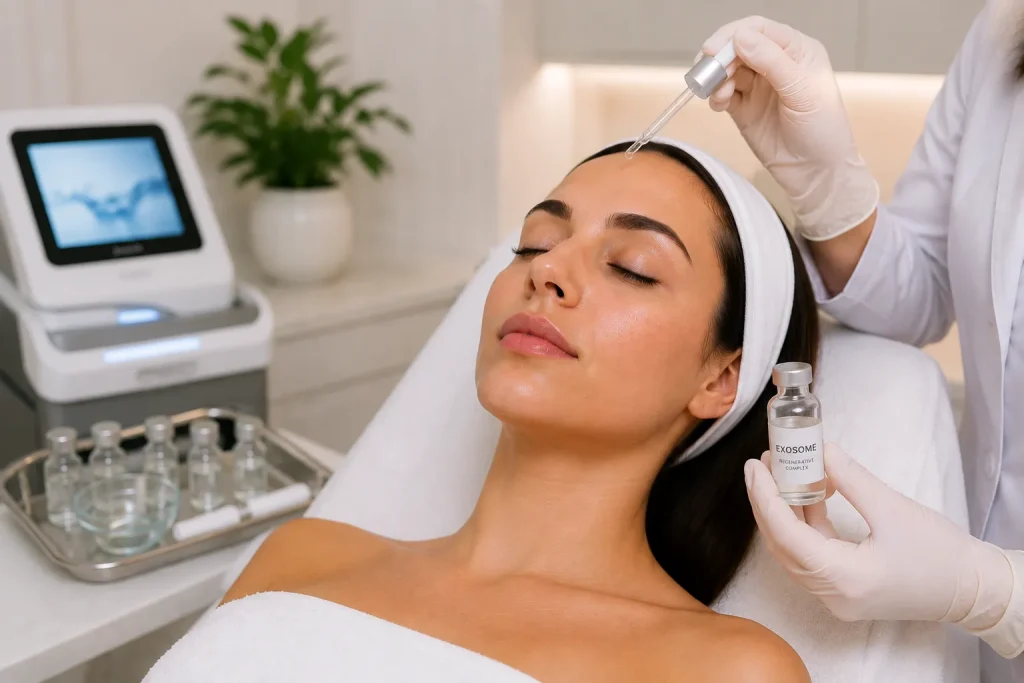
During each session, the exosome solution is applied to the treatment area following a preparation step that opens the skin to allow deeper absorption. The process is well tolerated by most patients, with minimal downtime compared to more intensive resurfacing procedures.
Combining Exosome Therapy with Other Treatments
One of the most effective ways to use this treatment is alongside other procedures. When applied immediately after microneedling or laser resurfacing, the exosomes enter the skin through the micro channels created by the treatment. This increases absorption and gives the signaling molecules direct access to the deeper layers where repair happens.
We regularly recommend it as a complement to our CO2 laser skin resurfacing in Philadelphia and our SkinPen microneedling sessions. Clients who combine these treatments consistently report shorter recovery periods and more noticeable results than those who undergo the resurfacing procedure alone.
Who Is a Good Candidate
Exosome therapy suits a wide range of patients. It works well for those in their thirties and beyond who are beginning to notice the effects of sun exposure and age on their skin. It is also a strong option for patients recovering from more aggressive procedures who want to support their skin through the healing process.
Patients with sensitive skin or those who are not good candidates for more intensive laser treatments often find this to be an accessible and effective alternative. As with all treatments at About Face Aesthetics, we assess each patient individually and build a plan around their specific concerns and goals.
Conclusion
Exosome therapy in Philadelphia represents a genuine shift in how we approach skin recovery and renewal. At About Face Aesthetics, we offer this as part of a comprehensive regenerative care menu for good reason. It works, it is well tolerated, and it delivers results that surface treatments alone cannot match. To find out whether exosome therapy belongs in your skin care plan, contact us today at (215) 923-5001 or visit us at 1015 Chestnut St, Suite 520, Center City Philadelphia.
FAQs
Is exosome therapy painful?
Most patients experience little to no discomfort during the session. The preparation step may cause mild sensitivity, but the treatment itself is generally well tolerated throughout.
How many sessions are needed?
Our standard program involves four sessions. Each appointment takes approximately thirty minutes, and results develop progressively across the course of treatment.
Can exosome therapy be combined with other treatments?
Yes. It works particularly well alongside microneedling and laser resurfacing, where it accelerates recovery and enhances the overall result.
How is exosome therapy different from PRF?
PRF draws on your own blood to stimulate healing. Exosome therapy delivers a targeted concentration of growth factors and signaling proteins directly to skin cells, producing a more precise and consistent cellular response regardless of individual biology.